
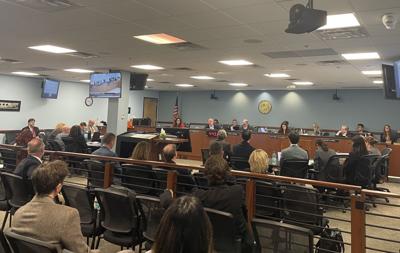

ACC commissioners deliver final comments before voting 4-1 in favor of a Tucson Electric Power rate increase on Tuesday, Nov. 17, 2026. (River Graziano/CALÓ News)
Despite fervent opposition from residents and local leaders, the Arizona Corporation Commission (ACC) voted Tuesday to approve a rate increase for Tucson Electric Power (TEP), along with an annual rate adjustment mechanism (ARAM) for the next five years.
The ACC voted 4-1 to approve a 10% revenue increase for TEP, with Commissioner Lea Márquez Peterson dissenting.
This will result in a monthly rate increase of 9.4% — about $13 a month for a resident on a basic plan. The change will be implemented on Dec. 1, 2026.
The decision drew staunch criticism from Arizona Attorney General Kris Mayes, who said the ACC rejected many consumer protections her office recommended.
“This decision is a bad deal for ratepayers. Instead of saving customers $148 million per year, as my Office’s expert witness suggested, the ACC has chosen unnecessary rate increases and electric bill instability for TEP’s customers,” Mayes said in a statement released Wednesday morning. “Every Arizonan should know the ACC decided to make it easier for TEP’s investors to earn a profit instead of siding with ratepayers struggling to make ends meet.”
The details of the new rate structure — which come in the form of a Recommended Opinion and Order (ROO) issued by a judge in October — were discussed extensively by commissioners, TEP representatives, intervening parties and public commenters over the course of the full-day meeting.
TEP first applied for a rate increase and ARAM in June 2025. After multiple public hearing sessions and closed briefings, Administrative Law Judge Julia Matter issued an ROO that included the proposed ARAM.
An ARAM, also known as a formula rate structure, allows a company to adjust its rates each year using a mathematical formula, rather than litigating a rate case each time it wants to raise rates. Those in favor of ARAM structures tend to believe this will reduce regulatory lag and save consumers money; those opposed believe rate cases are critical to incentivize efficiency and transparency from companies.
Demand to reject ‘autopilot rate hikes’ brushed aside
During the public comment section of the meeting, TEP ratepayers and energy affordability advocates addressed the Commission.
Shelly Burgoyne, the Southern Arizona Director of VetsForward, said that the ARAM will be especially detrimental to those on fixed incomes, many of whom are veterans.
“Veterans in Arizona deserve energy independence and affordable, reliable electricity that protects our region and state – not a blank check for billionaire utility companies,” Burgoyne said. “I strongly urge the commission to fulfill its legal and regulatory duty to the public, hold TEP accountable, and reject these autopilot rate hikes,” she added, referring to the rate adjustment mechanism.
Sandy Bahr, director of the Grand Canyon Chapter of Sierra Club, said that the ARAM “would create significant risks for rate payers that far outweigh any plain benefits. They weaken TEP’s incentives to control costs, reduce the commission's regulatory oversight, and sharply limit stakeholder participation.”
Others, like Ana Gorla, an organizer with Sierra Club, told CALÓ News that affordability is closely related to environmental concerns the organization advocates for, like renewable energy and data centers. Gorla had signed up to speak to the commission and had received confirmation via email, but her name was not called during the meeting.
“They greenwash gas into, ‘Oh, it's natural gas, it's cleaner’, but it's actually not. It's a lot more expensive as we've seen,” Gorla said in an interview with CALÓ News. “Also, the energy demand from data centers…that's trickling down to the prices and that's why [utility companies] are asking for all these rate increases.”
A report submitted to the ACC on Oct. 2 indicates that Arizona Public Service (APS) customers paid over $500 million as a result of data center development in their service area. During Tuesday's meeting, Commissioner Kevin Thompson cited the report and asked TEP representatives to confirm how new large-load infrastructure like Project Blue will be funded. According to TEP, customers will fund all new construction required for these projects, including Project Blue.
Vice Chair Walden later brought forth concerns about the impact of large-load consumers on rate increases, citing the planned construction of the Project Blue data center in TEP’s service area. After a recess and discussion among the commission, TEP representatives and rate case interveners, an amendment was proposed that would require TEP to conduct a cost of service study within 180 days if certain conditions related to large-load customers occur.
The details of these conditions were not disclosed at the meeting.
Several major amendments to the ROO were agreed upon before this meeting, including reducing the average residential utility rate from 13.7% to 9.4% and reducing the monthly basic service charge impact from $5 to $2.50 — averaging basic plan monthly bills to about $150.
At the Tuesday meeting, Márquez Peterson proposed amendments to eliminate the service charge entirely, as well as one to remove the ARAM structure from the rate case. According to the commissioner, most intervening groups supported these amendments, but the ACC failed to pass them after discussion.
The commission did, however, approve three key proposals made by the State of Arizona, according to the attorney general. These include a bill insert that explains to customers how the new rates will affect their monthly bills; the codification of TEP policy to not disconnect residential customers during extreme weather and submitting cost of service studies when working with new large-load customers, like data centers.
‘People over polluters’
During the public comment section, multiple speakers expressed frustration that the meeting was being held in Phoenix outside of TEP’s service area. While public comment sessions were held at the ACC’s Tucson office in March and April of this year — two of which were telephone-only — organizers like Gorla say this was not enough.
“I've been to two of these hearings that did happen with the judge out in Tucson,” Gorla said. “We saw the community show up in huge numbers, like Tucson shows up… I think that the commissioners need to be there in the communities to hear their voices.”
Commenters, including Gorla, said that they hope to see procedural changes after Democratic commissioners-elect Jonathon Hill and Clara Pratte, who were present at the meeting, are sworn in next year.
“We're really hoping that the decisions that [current commissioners] make on this reflect their promises to the people — that they choose people over polluters, over higher prices,” Gorla said before the final vote.
River Graziano is a freelance journalist for CALÓ News. They grew up in the Ahwatukee area of Phoenix and later attended ASU in Tempe, where they spent two years as an editor at The State Press. Their reporting with CALÓ News covers advocacy efforts impacting Latine communities across the Valley.









(0) comments
Welcome to the discussion.
Log In
Keep it Clean. Please avoid obscene, vulgar, lewd, racist or sexually-oriented language.
PLEASE TURN OFF YOUR CAPS LOCK.
Don't Threaten. Threats of harming another person will not be tolerated.
Be Truthful. Don't knowingly lie about anyone or anything.
Be Nice. No racism, sexism or any sort of -ism that is degrading to another person.
Be Proactive. Use the 'Report' link on each comment to let us know of abusive posts.
Share with Us. We'd love to hear eyewitness accounts, the history behind an article.